
- in Blog Articles by Erica Driver
IBM Lotus approach to Immersive Internet: partnering and professional services
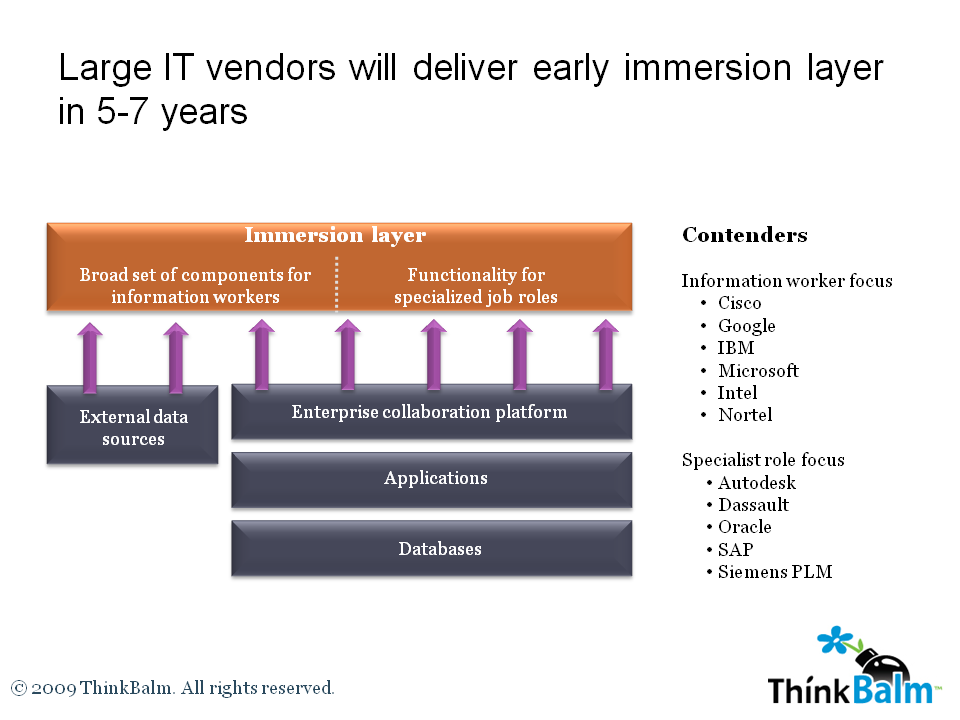
IBM Research is a big proponent of the Immersive Internet, especially in the Digital Convergence business unit. But what about the IBM Software group – in particular, Lotus, which produces IBM’s enterprise collaboration software products? ThinkBalm’s theory about the enterprise immersive platforms market is that ultimately software companies that provide information worker infrastructure (like IBM) will deliver an immersion layer that integrates with existing communication, collaboration, and content systems (see Figure). In search of validation (or invalidation, as the case may be) of this theory, this week I attended IBM’s Lotusphere conference in Orlando with one primary question in mind: Where does the Lotus group stand with regard to the emerging Immersive Internet market?
Searching for insights, I met with director of Lotus strategy Doug Heintzman, Lotus new business development executive Gopal Gupta, IBM Digital Convergence business unit marketing executive Karen Keeter, and others. I stopped by the innovation lab for a demo of Sametime 3D (see YouTube video below), which features collaboration spaces built in OpenSim and integrated with Lotus Sametime. In the innovation lab I also saw a demo of Olympus, a 2D Web overlay technology to add simple avatars to Web sites (in particular, Web conferences) in a similar vein to ROCKETON or Weblin. I wandered the show floor and visited Forterra Systems in their booth for a demo of the latest version of OLIVE and OLIVE integration with Lotus Sametime.
My takeaways after a couple of intense days at Lotusphere:
- Lotus is focusing on partnerships with third-party ISVs. Lotus is in the process of opening up APIs to products like Lotus Sametime so partners can integrate their products with IBM’s. The Lotus executive team is closely watching customer implementations of partner products like the Forterra OLIVE . Joint customers are just now beginning to drive adoption of each others’ products. Early indications are that IBM will initially evolve toward delivering an immersion layer via a partner ecosystem — though ThinkBalm’s take is that eventually (in 5-7 years) many aspects of immersive technology will go the same route as collaboration services (e.g., presence, instant messaging, calendaring, email, etc.) and find their way into an enterprise platform offered by large vendors like IBM.
- Lotus is keeping an eye on IBM Research developments. In September of 2008, IBM Research announced that it was doing work to integate OpenSim with Sametime in a project code-named “Sametime 3D.” Sametime 3D includes collaboration spaces for meetings, brainstorming sessions, and presentations. Sametime 3D does a good job of using 3D technology to do things that can’t be done using flat 2D technology – like brainstorming and then prioritizing ideas collaboratively. This week at Lotusphere, IBM made public that IBM Lotus and IBM Research are now offering an expanded version of Sametime 3D to customers that want to run Immersive Internet pilots, with plans to announce an IBM Software Service for Lotus (ISSL) offering later this quarter. Until this time, IBM’s Sametime 3D pilots had been internal-only.
IBM as a whole is taking groundbreaking steps with the Immersive Internet. And ThinkBalm expects that eventually large IT providers like IBM will offer an immersion layer that integrates with enterprise systems. (For more on this see the Aug. 13, 2008 ThinkBalm article, Information work is going immersive.) But this is a long-term vision. Don’t expect Lotus to develop an enterprise immersive platform on its own during the next 2-3 years. Instead, Lotus will expand relationships with Immersive Internet ISVs with which it partners, and work with those partners to integrate the immersive technology ever more deeply with products in the Lotus communication and collaboration portfolio. As the business value of the Immersive Internet in the enterprise becomes clearer and more widely understood over time, IBM will be right there in good position to capitalize on the growing opportunity.


